Dualisms, Avatars, Enlightenment, and The Perennial Philosophy
Dualisms, Avatars, Enlightenment, and The Perennial Philosophy
The problem with Western society (and much of Asian society as well) is something called a dualism. We arbitrarily hack Nature in two,
creating two previously non-existent parts, and then obsess about the disparity between them. Examples: mind/matter; good/evil; spirit/flesh; and the three most unfortunate of all: God/Man, God/Universe, and Man/Universe (because of the introduction of an imaginary being to explain what really doesn't need to be explained).
Numerous religions and schools of philosophy have been built up around this insanity, with the adherents arguing back and forth, or in many cases killing each other, over what amounts to semantics. Even the debate between atheists and religionists misses the point, because there is a Middle Way that avoids all the conflict and consternation. See my essay on the topic here.
The real world is right in front of your face, plain as day. You don't need credos and catechisms to grasp your place in the Universe. Once you figure out how to turn off your 'monkey mind' and focus on the Eternal Now, your 'existence' is no longer an issue or problem.* But of course,
that's the trick, isn't it? A trick that very few humans have accomplished throughout the ages.
Those that have--Buddha, Lao-Tzu, Bodhidharma, Ashtavakra, Krishnamurti, perhaps even Jesus--have typically devoted their lives to helping others
find enlightenment, once they have found it themselves.
So what exactly is Enlightenment? It has been written about extensively, but most who have experienced it (see list above) are reluctant to talk about it, because it is basically 'beyond words'. I myself have been on the cusp of attaining enlightenment many times--at least I think I have. There are times when I look at myself in the mirror and I get an odd feeling that I'm not really 'there'. I suppose if I were to pursue this further...
On the other hand, most spiritual teachers are quick to point out that the harder one grasps at enlightenment (satori, nirvana, or simply 'it'), the more elusive 'it' is. The old Zen addage of beating a drum in search of a fugitive
comes to mind.
Perhaps the simplest path to enlightenment that I have seen elucidated is the one attributed to the Vedic sage Ashtavakra. He said that one's true Self (i.e., the enlightened state) resides in that clear and quiet moment when all thoughts and memories have ceased. Your thoughts are not 'you'. Therefore, you simply let them pass without resisting, the way a man standing in a river does not resist the current. This is the first step towards 'mental health'.
Despite the elusive nature of Enlightenment, all of us have experienced it at least once in our lives, at least according to the experts. It has been theorized that infants come into the world with a kind of 'cosmic consciousness'. Because their senses, especially eyesight, are unfocussed and all-encompassing, they don't perceive themselves as individuals in an alien environment, but rather connected to the whole. The boundary between 'me' and 'everything else' does not exist for a newborn. Differentiation and personhood come later, through interaction with parents and society as a whole, and this is further enhanced by the acquisition of language.
~ ~ ~ ~ ~ ~
Aldous Huxley had another name for The Middle Way; he called it The Perennial Philosophy. Basically it's the central
message of Buddhism, Taoism, and Hinduism, after you strip away all the cultural trappings.
I have been studying these three ways of liberation since I was an undergrad (I prefer that terminology to 'religions', which are by nature confining and exclusionary). I was inspired to do so after reading "The Book" by Alan Watts, and I feel ever more strongly that Western society stands to gain so much if these teachings were better known.
Wishful thinking, of course, because The Middle Way/Perennial Philosophy has never been a driving force in any country or race of people. Even in the East, where these philosophies originated, it is in danger of disappearing entirely among the younger generations. In the West, it's a 'boutique subject' taught at many universities, but given the hegemony of the Abrahamic religions, the gentle tenets of The Middle Way have little chance of having an effect. This is especially sad in the U.S., given the current political climate, with its precipitous descent into fascism.
Meanwhile, empirical science has been inching slowly towards the mind-set embodied in The Middle Way, ever since the tremendous discoveries in quantum physics and cosmology of the 20th Century. But in my opinion it stops frustratingly short of the most important conclusion, namely that the Universe itself is 'alive' and 'intelligent'. (How could there be intelligent life in the Universe if the source itself were not intelligent?) However flawed, the human race is the end-product of billions of years of cosmological evolution, what non-scientists might call 'intelligent design'. We exist to bring consciousness into the Universe, and above all to recognize the path that leads to us.
Religionists like to talk about a Creator as the originator of 'intelligent design' (the former is usually identified as the God of Abraham). The world is so complex and intricate that it could only been created by an external agent,
so goes the argument.
Obviously they have never considered the alternative, that intelligent design was 'baked' into the Universe from the moment of the Big Bang, and that there is therefore no need for a creator (see 'dualisms' above). Because, you see, the Universe is all that there is!
~ ~ ~ ~ ~ ~
*Experienced students of The Perennial Philosophy will, of course, recognize that this statement is in itself a dualism, because 'you'
and 'the world' are in fact one and the same thing.
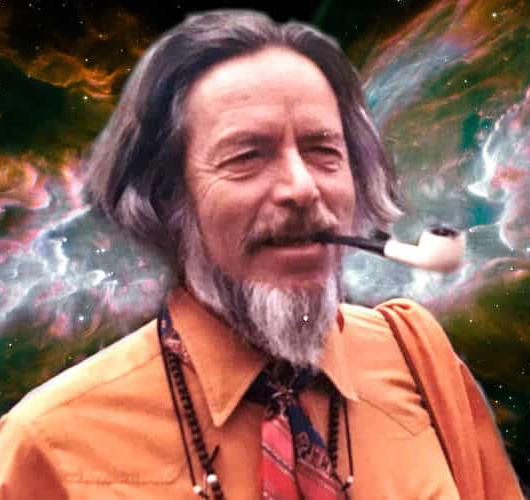
A List of Books by Alan Watts (from Wikipedia):
Watts, Alan W. (1932). An outline of Zen Buddhism. London: Golden Vista Press.
Watts, Alan W. (1937). The legacy of Asia and Western man: a study of the middle way. London: John Murray.
Watts, Alan (1940). The meaning of happiness: the quest for freedom of the spirit in modern psychology and the wisdom of the East (1st ed.). New York: Harper and Row.
Watts, Alan W. (1947). Behold the spirit: a study in the necessity of mystical religion. London: John Murray. ISBN 0-394-71761-9.
Watts, Alan (1950). Easter: its story and meaning. New York: H. Schuman.
The Wisdom of Insecurity: A Message for an Age of Anxiety. Pantheon Books. 1951. ISBN 0-394-70468-1.
Myth and Ritual in Christianity, Thames and Hudson, ISBN 0-8070-1375-7, including essay "God and Satan"
The Way of Zen. Pantheon Books. 1957. ISBN 0-375-70510-4.
Watts, Alan (1958) Nature, Man and Woman
Beat Zen Square Zen and Zen, contained in:
Watts, Alan (1960) This Is It and Other Essays on Zen and Spiritual Experience, Pantheon Books, ISBN 0-394-71904-2
Watts, Alan (1961) Psychotherapy East and West, Pantheon Books, ISBN 0-394-71609-4
Watts, Alan (1962) The Joyous Cosmology: Adventures in the Chemistry of Consciousness
The Two Hands of God: The Myths of Polarity
Beyond Theology: The Art of Godmanship, Pantheon Books, ISBN 0-394-71923-9
The Book: On the Taboo Against Knowing Who You Are. Pantheon Books. 1966. ISBN 0-679-72300-5.
Nonsense, illustrations by Greg Irons (a collection of literary nonsense), San Francisco: Stolen Paper Editions
Watts, Alan (1970) Does It Matter?: Essays on Man's Relation to Materiality, Pantheon Books, ISBN 0-394-71665-5
The Art of Contemplation: A Facsimile Manuscript with Doodles
In My Own Way: An Autobiography 1915–1965. Pantheon Books. 1972. ISBN 9781577315841., Vintage Books pocket edition 1973, ISBN 0-394-71951-4, New World Library edition, 2007, ISBN 1-57731-584-7
Cloud-hidden, Whereabouts Unknown: A Mountain Journal, Pantheon Books. Also published in Canada in 1974 by Jonathan Cape, ISBN 0224009729
© 2024 Kai Industries